

X
- No products in the list
The look and feel and, above all, the individual taste of every wellness enthusiast determine the choice of wood. Our selection of selected Wood types offers
optimum properties for use in saunas, steam baths, infrared cabins, bathing landscapes or for your individual building project. Heat-resistant and durable. Quality that lasts and gives pleasure for a long time.
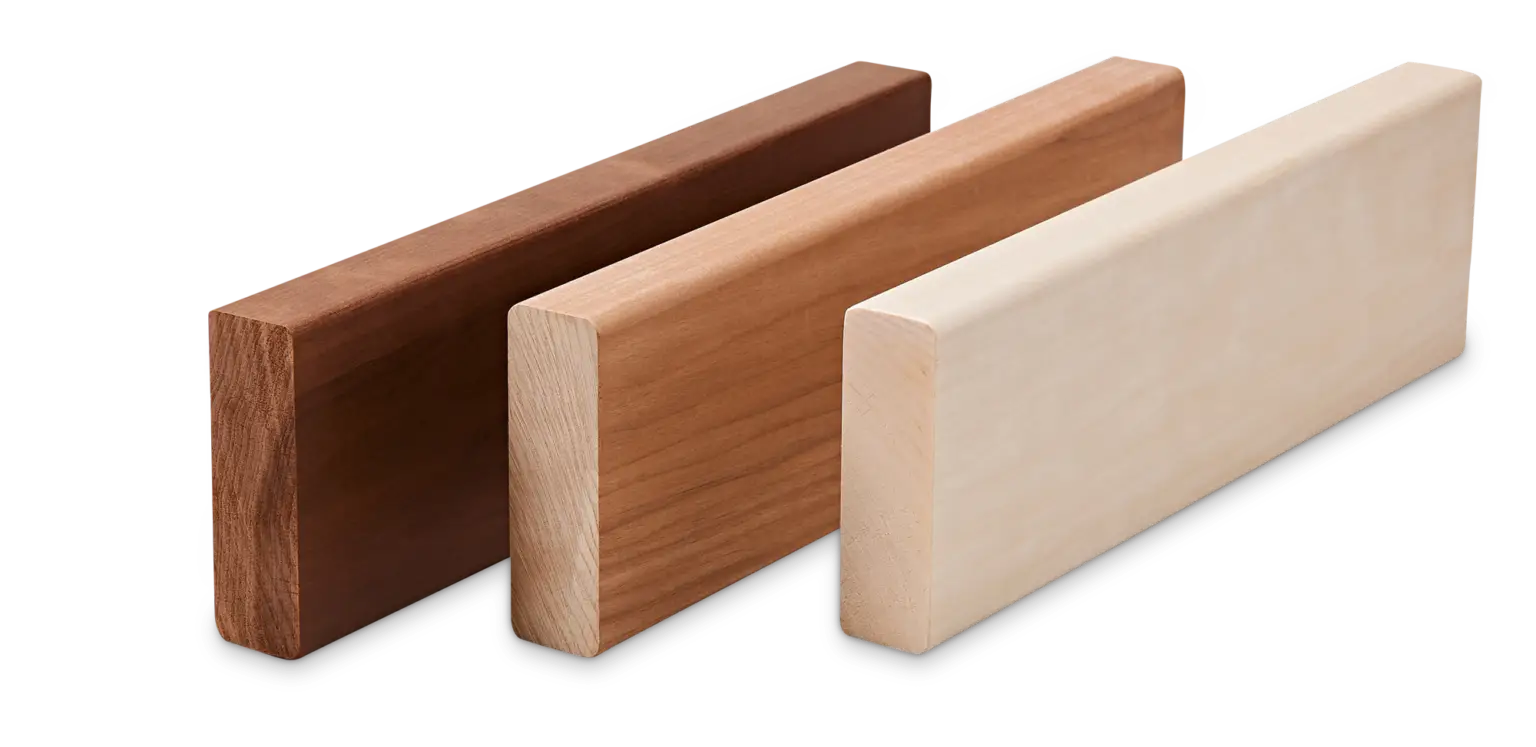
natural
before heat treatment
- Natural, untreated wood
- Light, natural color
- Higher wood moisture content
thermo medium
medium thermal treatment
- Temperature at approx. 195 °C
- Improves dimensional stability and durability
- For indoor applications, sauna & wellness facilities
thermo intense
intensive thermal treatment
- Temperature at a minimum of 215 °C
- Increased resistance to weathering and moisture
- Ideal for outdoor use
TMT (Thermally Modified Timber) has become established as the technical abbreviation for thermally modified wood. In German-speaking countries, the term "Thermoholz" is also frequently used. Thermally modified timber is the end product of a process for treating solid wood. The thermal treatment takes place in a thermal chamber in which the temperature, humidity and oxygen content are precisely controlled. The wood is slowly heated to 160 °C to 230 °C under steam, giving it its dark color. The treatment is carried out without any additional substances. 100 % chemical-free.
Originally light-colored domestic woods change their appearance through thermal treatment. Depending on the Wood types, they darken and develop a striking silver-grey color over time without oil post-treatment. The intensity of the color change depends on the duration of the thermal treatment, which is individually adjusted for medium or intense tones.
Another advantage of the reduced water absorption is the significant reduction in the swelling and shrinkage typical of wood. Thermowood "works" less - experts speak of "improved dimensional stability". As a result, joint spacing in decking boards and wall and façade cladding remains more uniform. Durability and dimensional stability increase with increasing treatment intensity and temperature. While even lower temperatures reduce swelling and shrinkage behavior, over 190 °C is usually required for increased resistance to wood-destroying fungi. The wood reacts less to humidity, reduces the risk of mildew and mold and tolerates heat much better.
An increase in temperature gradually removes the existing moisture from the wood, while the addition of water vapor serves to protect the wood from cracking. During this process, the moisture content of the wood is reduced to around 1%.
The temperature is now continuously increased, which initiates the thermal degradation of hemicelluloses. This leads to physical and chemical changes in the wood. The high temperature, typically between 160 °C and 230 °C, gives the wood a dark, noble color and the wood moisture content drops to 0%.
In the final step, the temperature is lowered again by adding water vapor. The wood moisture content gradually rises again to the final value of around 4-7%.
Thanks to natural regeneration and/or targeted afforestation, new trees constantly grow in an economically used forest – at least as many as are removed. This important principle is firmly anchored in the German Forest Act as well as in most European legislation. Thanks to sustainability, wood is an inexhaustible resource. Find out everything you need to know about certification here.
For more than 20 years, several certificates have been established that go beyond the legal requirements, defining further criteria for sustainability and setting special requirements. The well-known PEFC and FSC® systems certify forestry and the entire supply chain through to the finished product. In this way, the certificates serve as visible proof of defined sustainable forestry right up to the point of sale and can represent the supply chain transparently.
The specific requirements of the certificates go beyond the requirements of the forestry laws. For example, logging in the country of origin must not only be legal and deforestation-free, but must also comply with strict principles of sustainability. However, certified wood is only visible to the consumer if not only the forest of origin has a corresponding certificate, but also if this certificate is passed on in the supply chain via the wood processing industry, the specialist timber trade or craftsmen. Only then may the products be labeled with the PEFC and/or FSC® labels. In principle, the following applies: A certified product can only come from a certified company.
Buying certified wood is a good recommendation because this wood demonstrably meets the demanding criteria of sustainable and environmentally friendly forestry across all national borders. But even without a certificate, the principle of sustainability applies to wood in the German specialist trade. This is firmly enshrined in law and in principle in all European countries.


The use of wood has several positive effects on the climate. Firstly, it is a natural, renewable raw material that reduces climate-damaging CO2 in the atmosphere. Secondly, the carbon bound in wood is stored for many years in every roof beam, every chipboard and every wooden door. Both aspects of wood use (the reduction of carbon dioxide and the storage of carbon) are good for the climate.
Wood replaces stone and concrete, because wood can replace other materials that are much more energy-intensive and harmful to the climate in their production. The energy consumption of cement, for example, is four times higher than that of wood. For steel, the figure is even twenty times higher. For every cubic metre of wood, up to two tons of CO₂ can be saved in total
Wood is a renewable building material that is available regionally. This eliminates the need for long transportation routes that pollute the climate. Our local forests are managed sustainably so that no more wood is harvested than grows back year after year. This means that the raw material remains available for future generations.
It is particularly good for the climate if the carbon (C) remains bound in the wood for as long as possible. This is achieved through cascade utilization. This means that wood is used several times as a material before it is finally used for thermal purposes. However, the carbon storage effect of wood only works as long as the wood itself is preserved. Therefore, the following principle applies: wood is not a disposable product.